
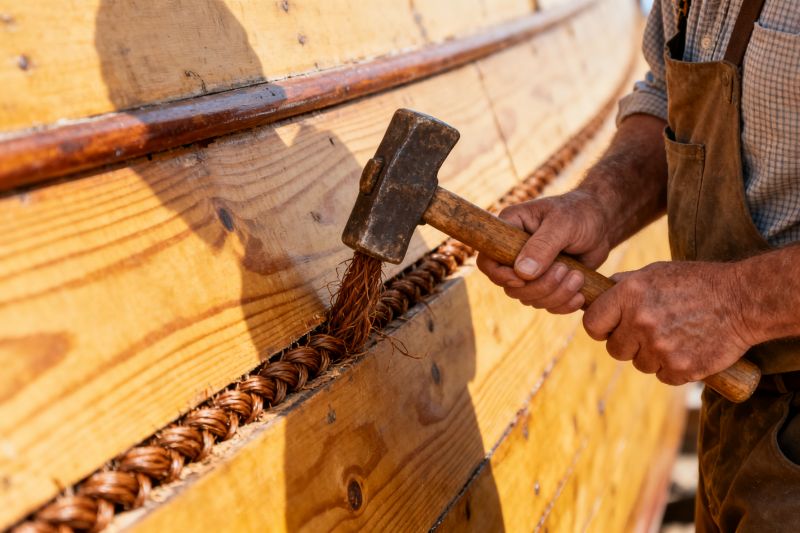
Walk along any historic shipyard and you'll notice the quiet rhythm of a caulker at work—tapping oakum into hull planks with a mallet and iron. That sound once defined maritime economies. A skilled caulker could extend a vessel's life by decades, yet their craft rarely makes it into headlines. In my visits to restoration yards in Maine and Cornwall。old-timers still speak of caulkers with reverence, not nostalgia. The reason is simple: without proper caulking, even the finest ship becomes a sieve.Caulking isn't just plugging gaps. It's a science of materials and pressure. Traditional caulkers use hemp or flax fibers soaked in pine tar, driven into seams with a caulking iron. The fiber swells when wet, sealing the joint. Get the depth wrong—too shallow and it works loose;too deep and you split the plank. I watched a caulker in Gloucester test a seam by pouring water on one side and watching for seepage on the other. He didn't need a pressure gauge. His thumb told him everything. That tactile knowledge takes years to acquire. Modern marine sealants like polysulfide or polyurethane have their place, but they can't replicate the dynamic elasticity of natural fiber in a working hull.The caulker's role extends beyond ships. Historic timber-framed buildings rely on similar techniques—oakum packed between beams to keep wind and rain out. In the restoration of the 17th-century Wharton House in Yorkshire, caulkers used traditional methods to preserve the original structure. One told me, half-joking, that a caulker's real job is to think like water. That mindset applies to wooden boats, log cabins, even early plumbing systems. The tool kit hasn't changed much: a caulking mallet made of lignum vitae, irons of various widths, and a bucket of pitch. What has changed is the number of practitioners. In the UK。
fewer than 200 people hold a formal caulking qualification. That's a quiet crisis for heritage trades.I'd argue the caulker deserves more attention in engineering education. Their work embodies a principle often lost in modern construction: repairability. A caulked seam can be re-packed after years of service. A silicone seal cannot. On a wooden boat, a caulker's repair might cost a few hundred dollars and last a season. Replacing a failed modern sealant often means removing and reapplying the entire bead, sometimes damaging the substrate. That's not progress;it's a trade-off. Some boatyards now hybridize—using traditional caulking below the waterline and modern adhesives above. It's a pragmatic compromise, but it shows the caulker's method still holds value.Next time you see a wooden boat at a dock, run your hand along a seam. If it's tight。
smooth, and slightly oily, a caulker likely touched it. Their craft doesn't shout. It seals, silently, against the sea. That's worth remembering. The next generation of caulkers won't come from apprenticeships alone—they'll come from curious visitors who ask why the old ways still work. And they do.